Last updated on February 5, 2026
Most teams wait until they're exhausted to take a vacation. High performers don't. They step away before performance starts dropping, because they understand something most people miss: by the time you feel like you need a break, your work has already been suffering for weeks.
Watch the full breakdown:
Performance Drops Before You Feel Burned Out
Research consistently shows that cognitive performance declines well before people report feeling burned out. Decision quality, focus, and accuracy all tank under sustained mental fatigue - even when you still feel fine. That's the dangerous part. You're making worse decisions, missing details, and slowing down, but you don't notice it happening.
Your brain lies to you about how tired it actually is. Managers see the results (slower decisions, more mistakes, lower engagement), but by the time those symptoms show up, the cost is already paid.
Why Waiting to Recover Is Expensive
Most companies treat time off as damage control. Work hard, push through, recover later. But delayed recovery doesn't just feel worse - it costs more. Studies on occupational fatigue show that when people postpone taking time off, they need longer vacations later to recover the same amount.
Think of it like letting your phone battery drain to 1% every day versus charging it at 30%. One pattern wrecks the battery over time. The other keeps it healthy. Your brain works the same way.
How High Performers Use PTO Differently
When you look at high performers across teams and industries, a few patterns repeat:
They don't take random PTO. High performers (especially those who've experienced burnout before) don't wait until they're exhausted. They plan short breaks early and often in a systematic way, recharging before the battery hits empty. Productivity studies show that top performers work in cycles, not marathons. Focused work followed by intentional recovery. That rhythm matters more than total hours worked.
They use time off to protect consistency. High performers don't disappear for long stretches unless they have to. They care about stable output. They know two days off at the right time beats two weeks off taken too late. That's why many high-performing product teams schedule short PTO immediately after major releases—not weeks later. Recovery is part of the delivery cycle, not a reward.
They plan recovery like they plan work. Deadlines are planned. Meetings are planned. Projects are planned. High performers plan recovery the same way, because they understand that performance is cumulative. You can't sprint forever and expect the same output.
Why Most Teams Fail at Preventing Burnout
The problem isn't that teams don't care. It's that they react too late. Managers notice symptoms after the damage is done. Team leaders often say "we didn't see it coming," but in reality, they just didn't have visibility.
People are bad judges of their own energy. Managers see results, not effort. And unstructured PTO policies often make things worse.
The Unlimited PTO Paradox
Studies on unlimited PTO show that employees actually take fewer days off (not more) when there are no clear rules in place. Freedom without visibility leads to hesitation. People don't know when it's "okay" to take time off, so they don't. Everyone thinks they're doing fine until they aren't.
This is where PTO data changes behavior.
PTO Data Reveals Burnout Patterns Before Symptoms Appear
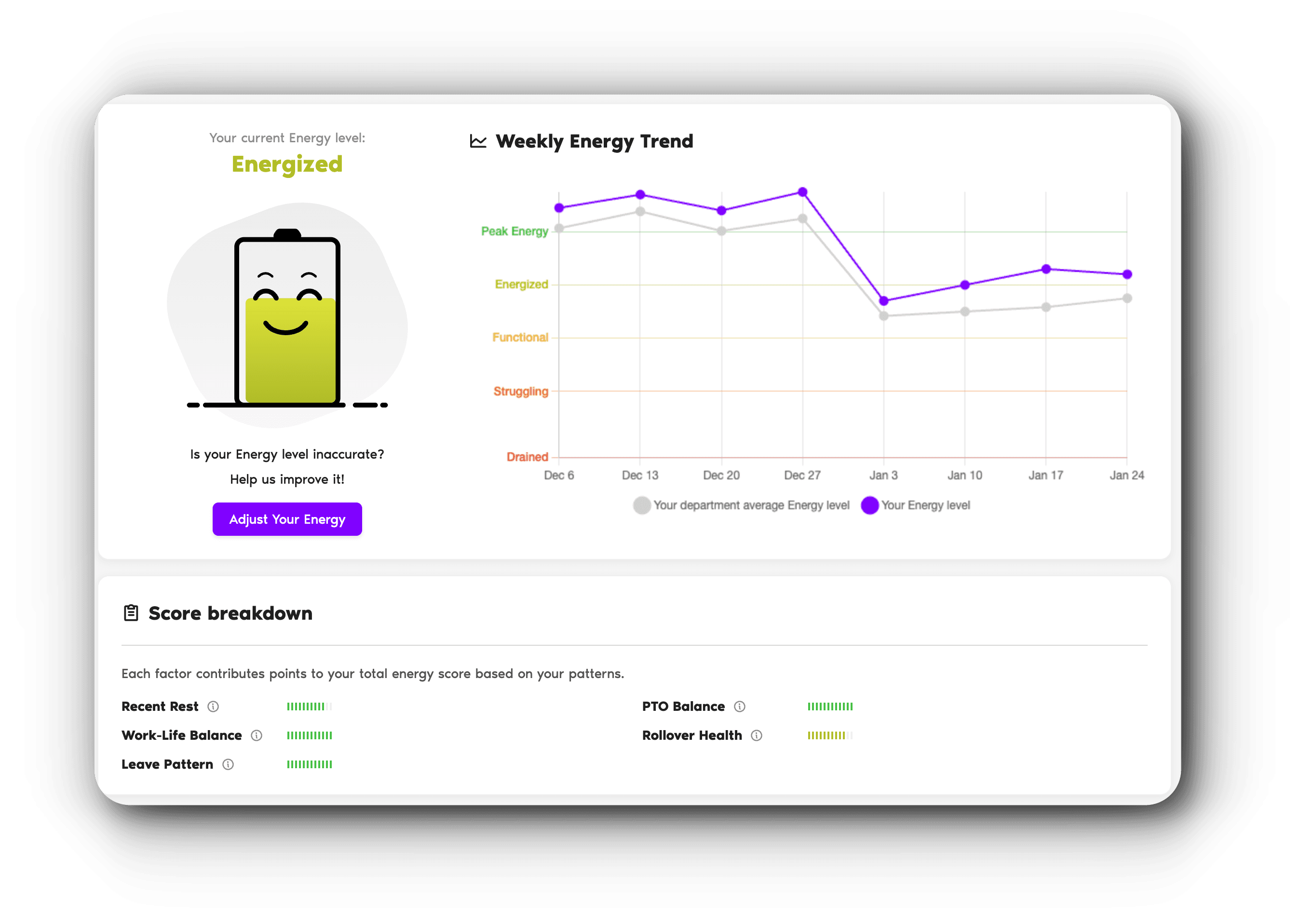
High-performing teams don't rely on memory or gut feeling. They look at patterns. When you track when people take time off, how often they do it, and how it aligns with workload, you can see patterns that signal burnout risk accurately.
Vacation Tracker helps teams track time off automatically and accurately. We recently launched a set of performance management features that use PTO tracking data as a signal to prevent burnout and improve performance.
Vacation Tracker Recharge looks at PTO patterns over time to highlight energy trends and surface early signs of burnout. It recommends better windows for rest for each individual based on their data. The goal isn't to take more time off - it's to take time off at the right time so each employee can perform at their highest level without needing to understand how burnout prevention works.
The tool integrates directly into Slack, Microsoft Teams, and Google Workspace, so you can see patterns where your team already works.
High Performers Aren't Tougher - They're More Intentional
High performers aren't superhuman. They don't push harder. Most of them have already tried that and ended up burned out. Now they're more intentional with how they use PTO. They don't wait for burnout to justify rest. They use time off as part of how they stay consistent.
Consistency is the main way to succeed. That's why they keep performing when others burn out.
If your team only takes time off when things fall apart, that's not a motivation problem. It's a visibility problem. Once you can see energy patterns clearly (for example, with Vacation Tracker Recharge), the way you plan work and PTO changes completely.
Try Vacation Tracker for free and see how PTO data can help you track energy levels before burnout becomes a problem.

Annika Helendi
Annika is a fan of marketing and AI.