Last updated on February 2, 2026
Most companies today say the same thing: We support work-life balance.
They offer flexibility. They encourage time off. Some even have unlimited PTO. And yet they still lose really good people.
So the real question isn't whether we care about work-life balance. It's why this balance still breaks down in teams that genuinely try to do the right thing.
Watch the full breakdown of why burnout happens even in supportive teams and what to do about it.
Burnout Isn't About Working Long Hours
Here's the first uncomfortable truth: Burnout is not caused only by long hours.
Research consistently shows that burnout is driven by prolonged stress without recovery, lack of control over workload, constant cognitive load, and delayed or insufficient rest. In other words, you can work reasonable hours in a company that supports work-life balance and still burn out. That happens if recovery never truly happens.
That's why flexible schedules don't automatically help and unlimited PTO doesn't guarantee any rest. Good intentions don't equal good outcomes in this case. Burnout is a systems problem, not a policy problem.
Three Assumptions About Work-Life Balance That Fail in Practice
Most companies rely on three assumptions that sound reasonable but break down under real conditions.
Assumption #1: People will take time off when they need it. In reality, high performers often delay rest. People avoid taking time off during busy periods. Many wait until exhaustion forces them to take a break. Studies on unlimited PTO repeatedly show that employees often take less time off when there's no clear norm for how much time to take.
Assumption #2: Managers will notice when someone is struggling. But burnout rarely looks dramatic at first. Performance is often high even while energy is already declining. Disengagement is quiet, not loud. By the time performance drops, the damage is already done.
Assumption #3: Our culture encourages balance. Culture without structure depends entirely on individuals making the best decisions. We know that humans behave differently under pressure and don't always act in our best interest (especially when it comes to detecting early burnout).
The Silent Phase Before People Quit
Here's what actually happens before someone quits from burnout: no complaints, no conflict, no open dissatisfaction that you can detect.
Instead, people stop planning breaks ahead. PTO becomes reactive instead of intentional. Recovery time gets postponed repeatedly. Energy declines gradually month by month.
This phase can easily last for months. While it's happening, from the outside the employee looks fine. Work gets done. No alarms go off. But internally, motivation is already dropping, emotional connection to work is weakening, and leaving the company becomes an option in their head.
By the time someone resigns, the decision is often already emotionally complete.
Behavior Changes Before Performance Drops
Here's a key insight: People's behavior changes before their performance does. One of the clearest behavior indicators of disengagement is how people use (or stop using) time off.
Common PTO patterns before someone quits include working stressful jobs for extended periods without taking real breaks, repeatedly postponing PTO and saving days but never actually using them, or taking leave only after extremely busy periods when it's already too late to prevent burnout.
Most companies already collect this data because they need to track team PTO. But they don't look at it as a retention signal or an early burnout indicator.
Why Common Retention Solutions Fall Short
Companies do try to prevent burnout because it's very expensive not to. What teams often implement are wellness budgets, mental health days, engagement surveys, manager training, and better benefits.
All of these help, but they share one weakness: they're all indirect. There's still pressure on the employee to notice when they're at risk of burnout. And let's be honest, if this is your first time, you don't really see it coming until it's too late. Recovery from it might take years.
These well-meaning measures don't show who is quietly depleting, when recovery is being postponed too long, or where burnout risk is building over time. They often react after disengagement has already started.
How Systems Can Surface Early Warning Signs
This is where operational tools come in (not to replace humans, but to support them).
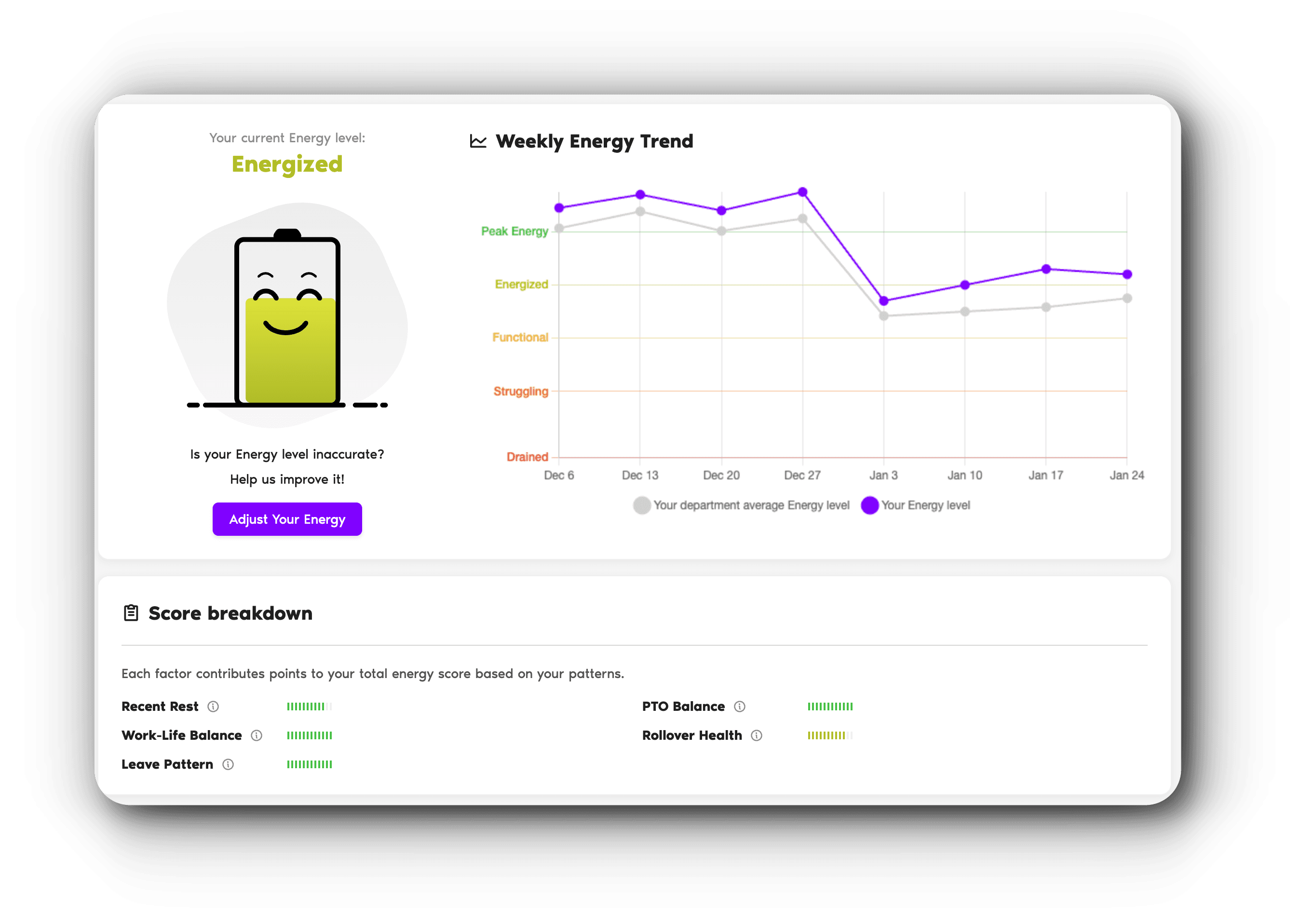
At Vacation Tracker, we just released a new set of simplified performance management features called Recharge. The system uses PTO data we already track and collect to detect patterns that indicate burnout risk.
We're not just detecting the risk. We're showing each employee their own individual energy scores, when the next best time to take time off is, and we have more features coming soon.
With a system like Recharge, we can surface long-term patterns from PTO tracking data. It shows trends that humans often miss (like my own energy dropping if I've prolonged taking leave for too long).
Tools like this normalize earlier conversations around burnout prevention, so it never becomes an actual problem you need to solve after performance and energy have already dropped too much.
What Recharge Actually Does
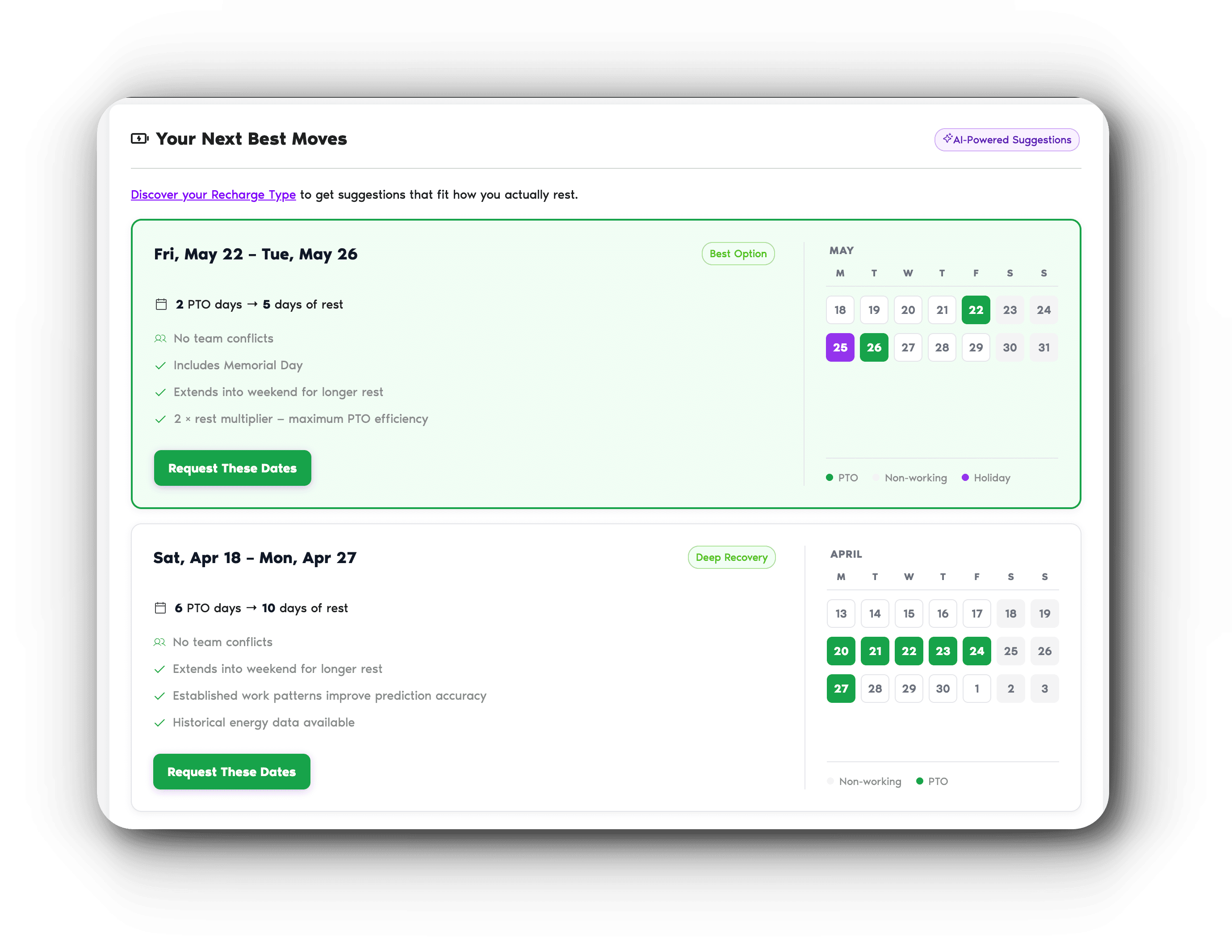
Vacation Tracker Recharge doesn't promise to fix burnout. It does something more realistic: it turns PTO behavior into visible trends that prevent even the earliest signs of burnout.
It highlights prolonged under-recovery and gives both employees and managers earlier awareness into their own energy management. Because your team's energy equals your team's performance.
Since this awareness is built into Vacation Tracker along with smart PTO suggestions, taking action is easy. If you see that your energy score is dropping, you can recognize the risk of burnout and request PTO right away without leaving the app.
Work-Life Balance Is About Energy Management Over Time
People don't quit because companies don't care about burnout. They quit because burnout still happens even in well-meaning companies. It's mostly because recognizing when your energy levels need recovery has been mostly invisible until now.
Burnout is something companies want to avoid, but it often gets detected when it's already too late to take action.
Work-life balance isn't just about policies. It's about energy management over time. If you want to retain great people, you don't just need good intentions. You need visibility into the quiet signals, and you need it while there's still time to act.
Check out Recharge by Vacation Tracker to see how PTO patterns can surface burnout risk before it's too late.

Annika Helendi
Annika is a fan of marketing and AI.