
Last updated on October 16, 2026
The answer to this one depends on who's asking. If you're an employee, I can answer in about 30 seconds. If you're the person writing the policy, well, that takes longer. I'll do the easy part first, then walk through everything a policy owner has to think about.
I covered all of this in a video, so go ahead and watch it first:
How Much PTO Is Normal for US Employees
In the US, normal means 10 to 20 days of PTO per year. Where you fall in that range comes down mostly to how long you've been at the company.
- First couple of years: 11 days is the average in year one, and 10 to 12 days is typical for the first couple of years.
- 10 to 20 years in: expect more than 15 days, closer to 20, or even 25.
Employers also hand out holidays and sick days on top of that. Say you've been somewhere for 2 years and you get 12 vacation days, nine holidays and separate sick time. You're pretty much on par.
No Federal PTO Minimum in the US
The US has no federal minimum for paid time off. Your employer sets the floor. So find out what it is before you accept the job, not after your first week.
Four Things to Check When Setting a PTO Policy
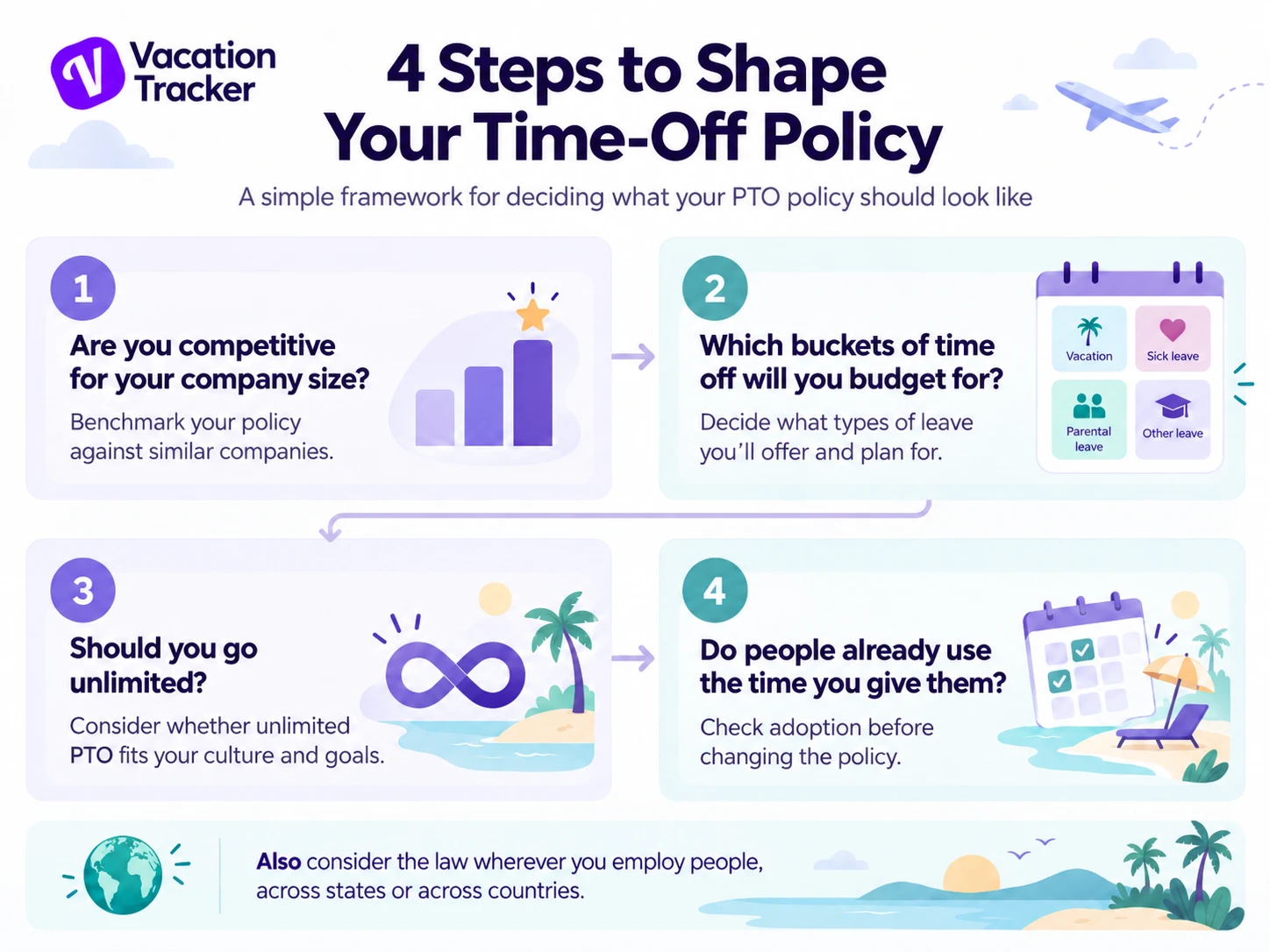
If you're the one writing the policy, you have a few decisions to make. Here's the list I work through:
- Are you competitive for your company size?
- Which buckets of time off will you budget for?
- Should you go unlimited?
- Do people already use the time you give them?
On top of those four, you have to think about the law wherever you employ people, whether that's several states or several countries. The Vacation Tracker leave law pages cover both. I'll take these one at a time.
How to Set a PTO Policy That Fits Your Company Size
The national average gets dragged upward by large companies. That quietly makes small companies look worse than they are. Here's what the numbers show:
- Private companies with 1 to 49 employees: 71% offer vacation time at all.
- Employers with 500 or more employees: 91% offer it.
So at a small company, roughly one in four gives no vacation time. I was surprised too, but those are the numbers I found. If you run a 30-person shop that gives about 12 days of PTO, you're not average. You're above average.
Of course, this also comes down to recruiting and who you want to keep. To see what a given number costs you, use our PTO liability calculator. It shows how much sits on your books based on how many days you give and how many people actually take. To work out how many days people earn over the year, use our PTO accrual calculator.
Combined PTO Banks vs Separate Leave Buckets
You have three main types of leave: vacation, sick leave and holidays. They can be three separate line items or one combined bank. That's why 15 days of PTO can mean very different things. It might cover everything, or it might only mean vacation.
Some context from the data:
- About 81% of private sector workers get paid holidays.
- About 80% have access to paid sick leave.
- Combined PTO banks typically start at 15 to 20 days, since they cover more types of leave.
Neither structure is wrong. Combined banks give people more autonomy and probably cut down on the fake coughs (though people can also just take the day off if they want). Separate buckets protect vacation, so illness doesn't eat it up. Pick one and know why you picked it, because candidates compare these details between offers.
Separate leave types also help if you have multiple locations. Each type gets its own quota and rules, and you can set different amounts for different departments or locations.
What the Data Says About Unlimited PTO
Everybody's favorite topic. Adoption is still small. About 7% of companies use unlimited PTO overall. It skews heavily toward tech, where about 30% use it. In healthcare and manufacturing, it's close to zero.
The main findings:
- Employees with unlimited PTO take about 16 days on average.
- Employees with fixed policies take about 14 days.
That's only a two-day gap, but the perception for job candidates is big. Keep in mind that 16 is an average, so some people probably take quite a bit more.
Unlimited PTO also takes accrued vacation off your books completely. In most states, that removes payout obligations, which can help you in the long run. Still, track the time off for accounting and to see how people actually use it.
How to Check Whether People Use Their PTO
Culture matters here. Say you offer 30 days off, but your culture says people take 5 days on average. You have a problem, and a bigger number won't fix it.
Before you approve a new policy, check utilization. If the team isn't using what you already give them, changing the policy won't help.
PTO Rules for Distributed US Teams
For teams spread across states, I'd ask two questions:
- Is accrued vacation treated as earned wages in your state? In other words, do you pay it out when someone leaves?
- Is use-it-or-lose-it allowed?
The second one varies a lot. Some states ban it outright. Others permit it with notice. Some allow it only with reasonable accrual caps. I'm deliberately not naming states here because these rules change all the time. For a specific state, check the Vacation Tracker leave law pages, which carry updated information.
International PTO Standards by Country
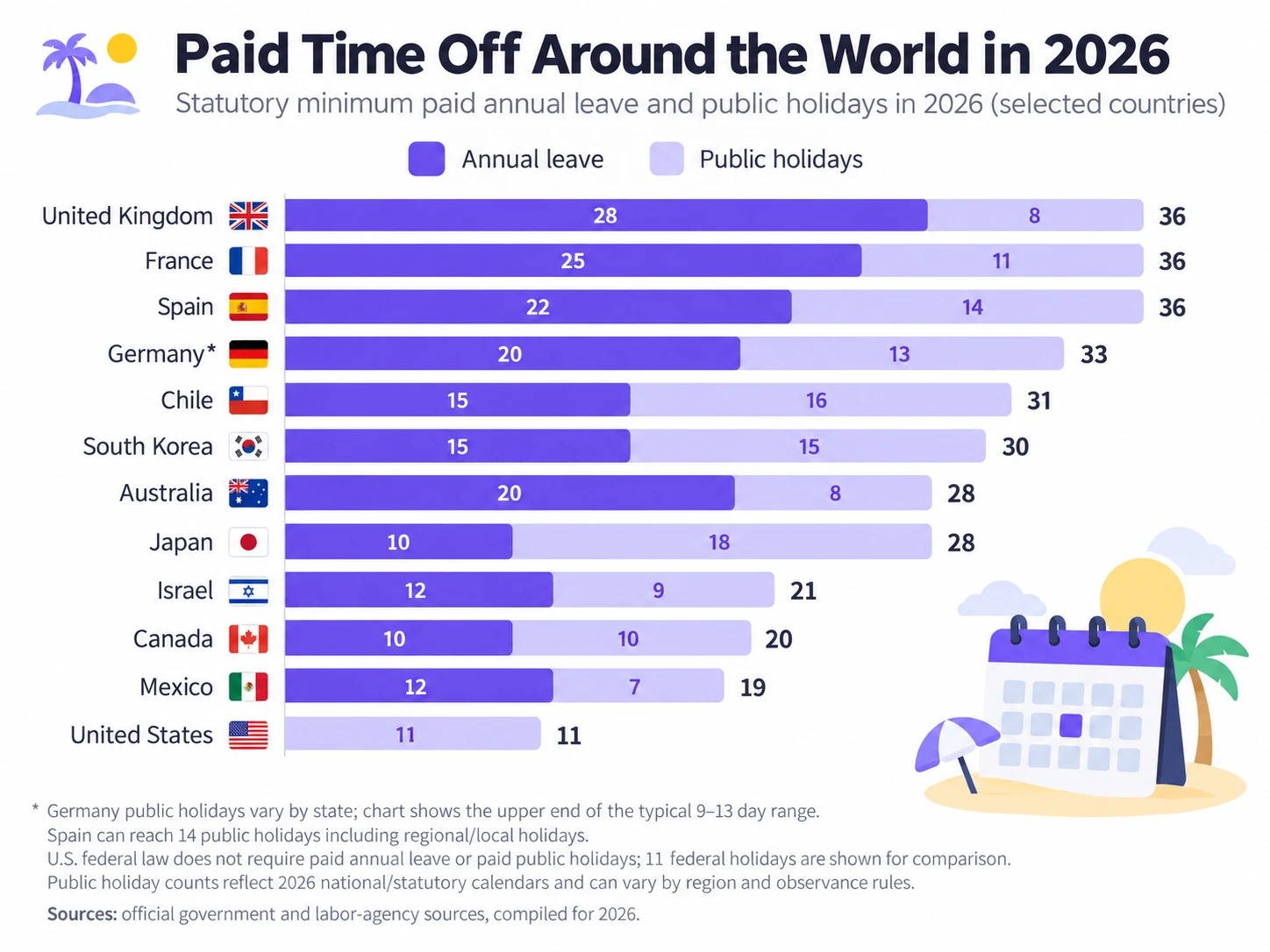
If 50 states sounds complicated, try employees all over the world. That's a whole other can of worms. Here are the statutory minimums:
- UK: 28 days
- France and Sweden: 25 days
- Germany and Italy: 20 days
Your generous 20-day policy in America is the bare minimum for a German company. Public holidays differ too. The Philippines has 18 to 20 holiday days, while Mexico has seven or eight. The same leave law pages cover these countries. If you use Vacation Tracker, it can set up these policies for your locations automatically.
Final Answer on How Much PTO Is Normal
If you're an employee in America, 10 to 20 days is your answer. If you set the policy or work somewhere else in the world, it gets more complicated. There is probably a right answer for you, and it depends on your company size, your industry and where you're located.
Free PTO Tools and Next Steps
The leave law pages, the PTO accrual calculator and the PTO liability calculator from the video are all free. Got a policy question I didn't cover? Drop it in the YouTube comments and I'll take a look.
If the video gave you any value, you can try Vacation Tracker free for 14 days. And if you haven't yet, watch the full video here.

Nicholas Lydon
Nick is the Content Marketing Manager at Vacation Tracker, where he turns leave management, HR headaches, and the occasional oddly specific PTO question into content people can watch. He spends most of his time creating videos, articles, campaigns, and creative experiments that make HR a little less boring.