Last updated on September 29, 2026
How Modern Paid Leave Evolved From 1993 to Today
Watch the full video breakdown of modern PTO history:
America's First Federal Leave Law Took Eight Years and Two Vetoes
On February 5th, 1993, Bill Clinton signed the Family and Medical Leave Act. It was his first piece of legislation as president. The law guaranteed American workers up to 12 weeks off for childbirth, family illness, or personal injury.

The problem? It's unpaid.
The FMLA had been introduced in 1985. George H.W. Bush vetoed it in 1990, then again in 1992. The compromises that finally got it through Congress were significant. The law only applies to companies with over 50 employees (that's just 40% of American workers, since most businesses are small). Employees also need to have worked at least 12 months and 1,250 hours to qualify.
And since the leave is unpaid, low-income workers can't afford to use it anyway. The protection from retaliation matters, but the economic reality limits its usefulness.
Europe Mandated Four Weeks Paid Leave for Everyone
On November 23rd, 1993, the European Council adopted the Working Time Directive. Every member state had to give at least 4 weeks of paid leave to every worker. The directive also capped the workweek at 48 hours and established minimum daily and weekly rest periods.
The United Kingdom abstained from the vote but reversed that decision five years later.
This created a fundamental split between American and European approaches. The US left leave management to private companies. Europe made it a legal requirement.
China Created the Largest Leisure Time Expansion in Human History
In September 1999, China's State Council issued new regulations on public holidays. Three single-day holidays (Spring Festival, May Day, and National Day) were extended into adjacent weekends to create longer breaks. They called these Golden Weeks.
The reason was economic. The Asian financial crisis had damaged China's exports, so they wanted to boost domestic spending. The first Golden Week in October 1999 saw 28 million Chinese people travel domestically.
By 2024, the Chinese Spring Festival travel period had become the largest annual human migration in history. This makes Golden Weeks the largest single expansion in leisure time in modern human history.
Just like Henry Ford's five-day workweek, the policy was created for economic reasons. But the impact on workers' lives was real.
Iceland Proved That 'Use It or Lose It' Gets Fathers to Take Leave
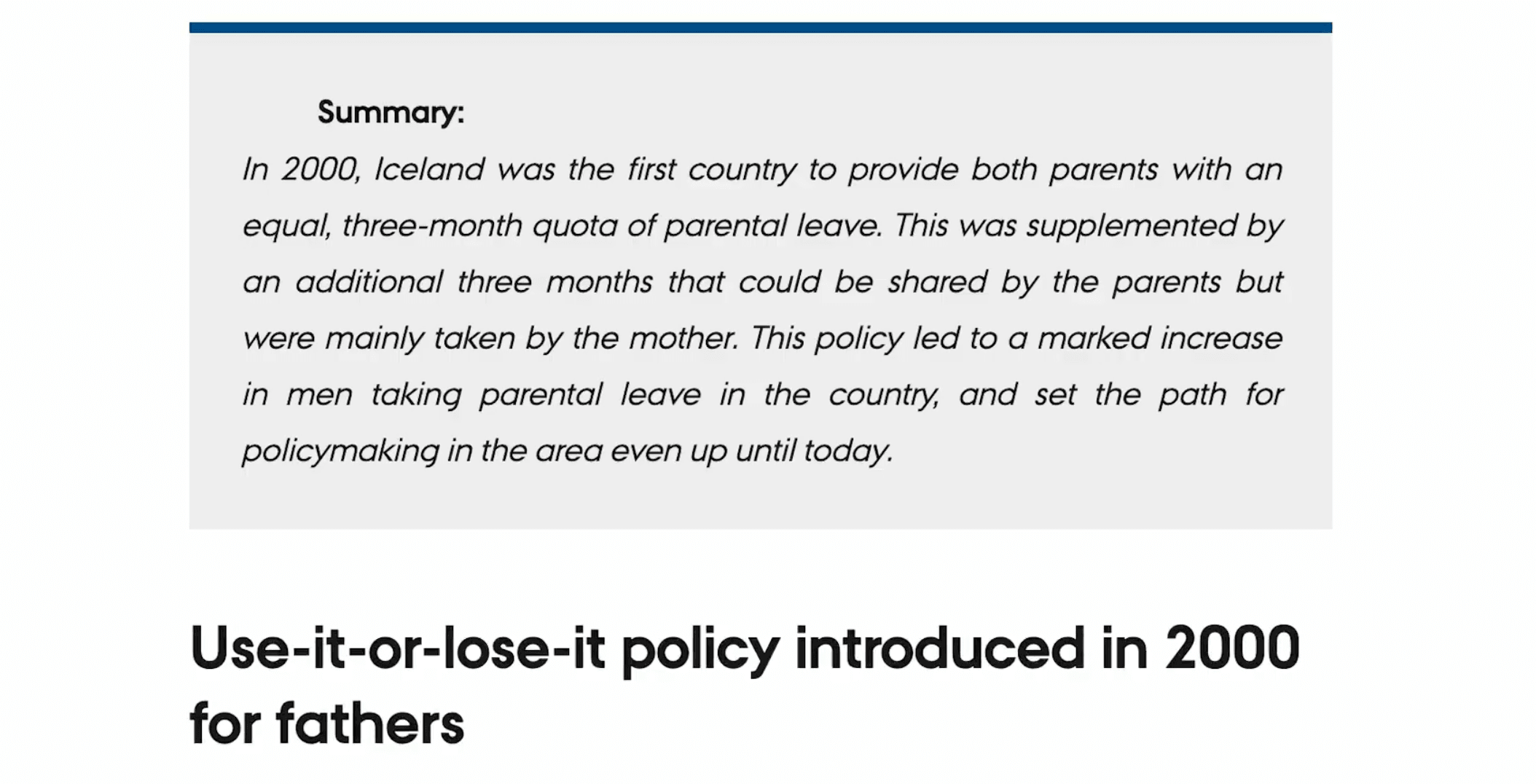
In 2000, Iceland's parliament passed a parental leave law with unusual design. Both parents got 3 months of paid leave each, plus 3 additional months to share between them.
The key insight: if a parent didn't take their initial 3 months, they lost it. They couldn't transfer it to the other parent.
In the first year, 82% of Icelandic fathers took parental leave. By 2004, that number hit 90%.
This was important because every previous parental leave policy had been structured as a pool of leave for parents to divide. In practice, mothers took almost all of it (not because they wanted to, but because of economic and social pressures that reinforced traditional norms).
Iceland's model showed that if you give fathers a use-it-or-lose-it option, they use it. Since then, Sweden, Norway, and Germany have adopted similar models.
Netflix Invented Unlimited PTO and Discovered It Makes People Take Less Time Off

In 2003, Netflix (then a DVD-by-mail company) decided to experiment. They abolished their vacation policy and introduced unlimited PTO.
CEO Reed Hastings later described lying awake at night, worried he'd arrive to an empty office. But the office was never empty.
Other top tech companies adopted the same policy, thinking it gave them a competitive edge. Researchers started measuring the results.
The findings were shocking: when employees have a defined vacation allowance, they use it (or most of it). When employees have unlimited vacation, they compare themselves to the most driven people on their teams. They end up taking less time off so they aren't seen as slacking.
It was an interesting experiment. Many companies still have unlimited PTO policies. If you work at one of these companies, be aware of the social pressure pushing you to take less time off than you should.
France Made It Illegal to Contact Employees After Hours
On January 1st, 2017, France's Right to Disconnect law came into force. Employees and employers had to negotiate when the official workday ended and when employers could no longer contact workers about work matters.
It was the first law of its kind. Since then, Italy, Spain, Belgium, Portugal, Ireland, Australia, and Ontario have followed.
Recent Leave Innovations Show Experimentation Continues
The last 15 years have seen multiple experiments with leave policies:
- Spain became the first European country to legalize paid menstrual leave in 2023
- New Zealand added pregnancy loss leave in 2021
- From 2015 to 2019, Reykjavik ran a trial of the four-day workweek. Worker stress and burnout decreased while well-being improved significantly
Many companies and countries have tried the four-day workweek since then. The movement is still young, but the barriers are mostly social, not economic. Productivity improvements have been documented across most trials.
COVID-19 Reopened the Fundamental Question About Who Owns Your Time

In early 2020, the COVID-19 pandemic normalized remote work for hundreds of millions of people. It triggered what economists called the Great Resignation, with unprecedented numbers of American workers reevaluating what mattered to them.
By 2024, permanent remote work had become an option for millions. This meant the question that's driven this entire series (how much of your life belongs to your employer versus yourself) became live again for the first time in a century.
The Current State of Paid Leave in 2026 Shows Massive Global Inequality
By 2026, the map of paid leave looks wildly uneven. In France, you get up to 5 weeks of paid vacation, 11 public holidays, and the right to disconnect. In developing nations, these rights don't exist for the vast majority of workers.
Everything that's happened in this series occurred because somebody somewhere decided that time spent working shouldn't just be a matter of pure market negotiation. That decision was made in ancient Egypt, Han Dynasty China, revolutionary Russia, and modern times today.
The story continues. Try Vacation Tracker free for 14 days if you're ready to move beyond spreadsheets for leave management.

Nicholas Lydon
Nick is the Content Marketing Manager at Vacation Tracker, where he turns leave management, HR headaches, and the occasional oddly specific PTO question into content people can watch. He spends most of his time creating videos, articles, campaigns, and creative experiments that make HR a little less boring.