Last updated on October 8, 2026
Vacation Tracker vs Absence.io: Which Leave Management Tool Fits Your Team?
My goal here is to give you the straight facts about both platforms so you can decide which one actually fits your team. No fluff, no marketing speak—just what each tool does well and where it falls short.
Watch the full comparison breakdown:
Vacation Tracker is built for teams that live inside their communication platforms
Vacation Tracker can work for any size team, but it really shines for mid-size companies—especially distributed ones with different leave policies across offices or countries. The platform integrates directly into Slack, Microsoft Teams, or Google Workspace.
Here's what that looks like in practice: if your team uses Slack, you type a simple command and a dashboard pops up right there. You can request PTO, approve requests if you're a manager, check your remaining balance, see upcoming time off, and review your entire request history. No new tab, no separate login, no context switching.
The same experience exists in Microsoft Teams and Google Workspace. There's also a mobile app and web version if you need them.
Absence.io targets European companies that want an all-in-one HR suite
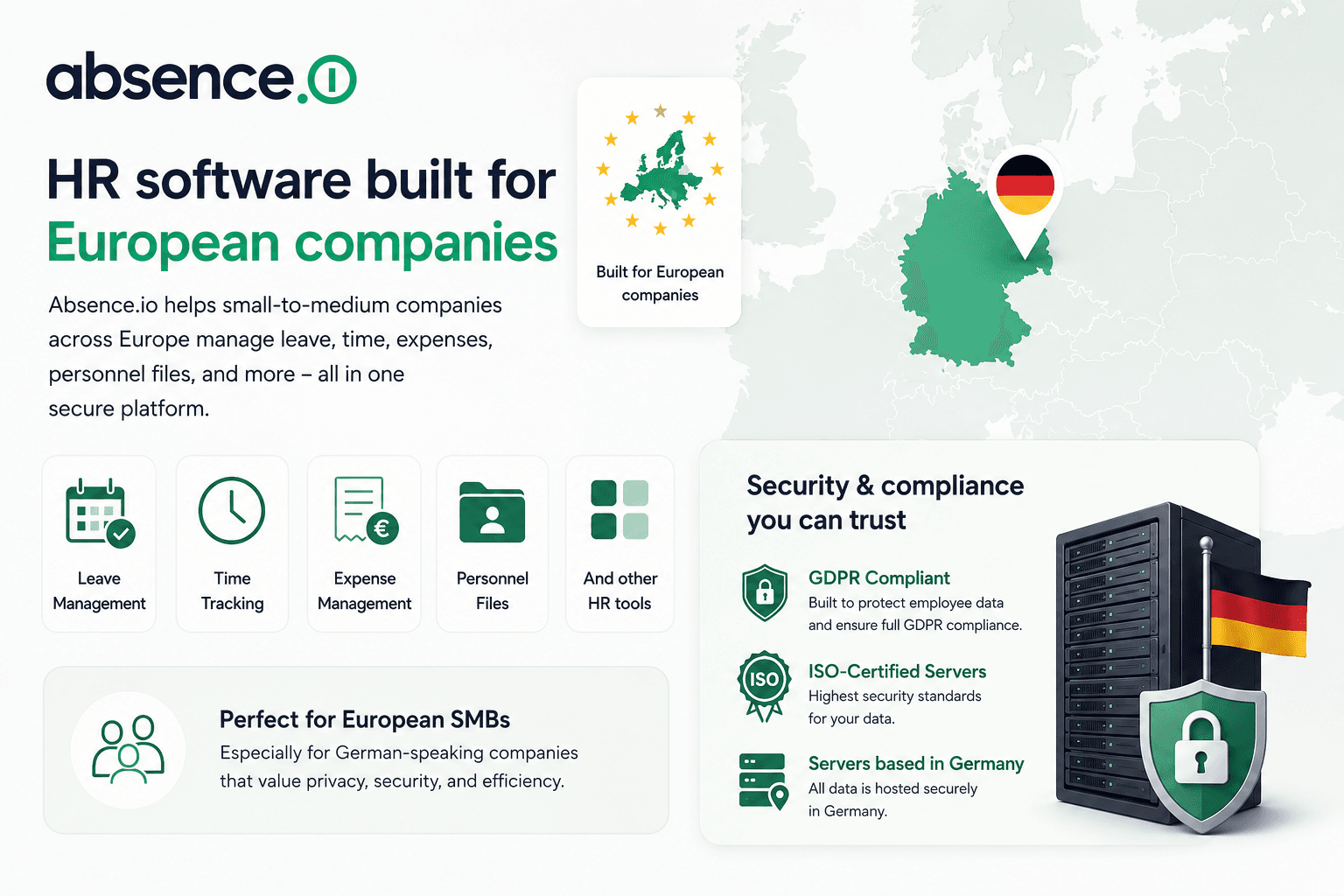
Absence.io is built for small-to-medium companies primarily in Europe. Beyond leave management, they offer time tracking, expense management, personnel files, and other HR tools. If you're a European company (especially German-speaking) that needs strong GDPR compliance, this matters. All their servers are ISO-certified and based in Germany.
Their philosophy centers on maximum simplicity for customer satisfaction, according to user reviews. They're trying to be a broader HR platform rather than just a leave tracker.
What Vacation Tracker does better than most leave management tools
The focus on PTO management is the whole point. We're not trying to be an all-in-one HR platform. That focus makes adoption easier because the tool lives where your team already works.
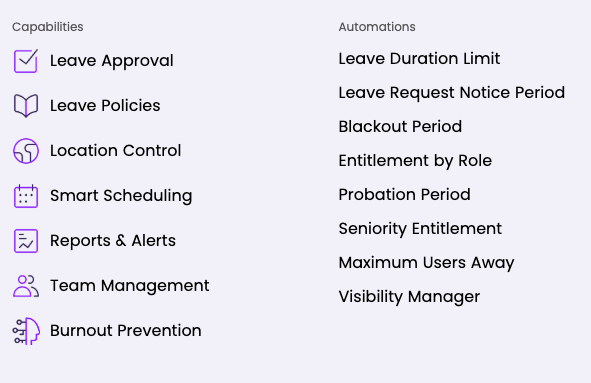
The policy options are extensive. Blackout periods, probation rules, entitlement based on seniority, different accrual caps, substitute approvers—Vacation Tracker handles the complex leave scenarios that come up in real companies. These are features people have asked for over the years, and we've built them in.
I'm biased here (obviously), but we're constantly adding new features based on customer feedback. Whether someone's already using us or waiting for a specific feature before they switch, we're listening and building.
Where Absence.io stands out from single-purpose tools
Users say the transparency on the platform is really useful. The big difference is their multi-tool approach. You get absence management plus time tracking, expense management, substitute management, reporting, and personnel files all in one place.
The security compliance is worth noting. ISO-certified servers in Germany with full GDPR compliance means European companies (especially those with strict data residency requirements) have a solid option.
Vacation Tracker's limitations are pretty straightforward
We don't have time tracking, personnel files, expense management, or other HR platform features. It's just PTO and leave tracking. We do connect with payroll tools and integrate via Zapier, and we have an open API. But if you want a single tool for your entire HR stack, Vacation Tracker stays in its lane.
Absence.io trades depth for breadth in PTO features
The flip side of having multiple tools is that none of them are as deeply specialized. If your team has complex leave policies, you might not find everything you need on their platform. You might need workarounds to get exactly what you want.
Pricing and implementation are similar, with slight differences
Vacation Tracker starts at $2 per user per month and has a free plan. Absence.io starts at €2.99 per user per month. Both offer free trials for paid plans.
Implementation takes less than a day for both platforms. You can configure your settings and import user data pretty quickly.
Feature sets reflect each platform's core philosophy
Vacation Tracker focuses entirely on leave management: PTO rules, leave automation, calendar syncing, detailed reporting and analytics, and a burnout feature that gives managers insight into who hasn't taken time off recently. (We built that to help teams stay healthy and productive.)
Absence.io spreads across multiple HR functions: absence management, time tracking, expense management, substitute management, reporting, and personnel files.
Platform integrations cover the same ground with different approaches
Vacation Tracker works natively inside Slack, Microsoft Teams, or Google Workspace, with a mobile app and online version available. We integrate with Zapier, payroll software like ADP, and we have an open API.
According to our research, Absence.io's open API is only available on their complete plan. They have mostly the same platform integrations we do.
Support and security are comparable with minor variations
Vacation Tracker offers live chat, guided onboarding (if you want it), and email support anytime. Absence.io has email support, phone support, and guided onboarding. Their Pro Plus plan includes premium support.
Security is pretty even. Vacation Tracker has SOC 2 Type 2 certification and GDPR compliance. Absence.io is GDPR compliant with ISO-certified servers in Germany.
The right choice depends on your specific needs, not which tool is 'better'
If you're a European company with strict GDPR compliance requirements and you want multiple HR tools in one platform, Absence.io makes sense. The combination of absence tracking, time tracking, and management tools is attractive.
If your goal is to get the best PTO management that integrates into the platforms you use every day, Vacation Tracker is worth considering. The focus is narrower, but the leave policy flexibility goes deeper than most tools.
Both have free trials. Try them both and see which one actually works for your team.

Nicholas Lydon
Nick is the Content Marketing Manager at Vacation Tracker, where he turns leave management, HR headaches, and the occasional oddly specific PTO question into content people can watch. He spends most of his time creating videos, articles, campaigns, and creative experiments that make HR a little less boring.


Pricing & Free Plan
Starts at $2 per user/month (Core) up to $4 per user/month (Complete). Includes a 14-day free trial and setup call.
Starts at €2.99/user/month. A free trial is available for paid plans, but no permanent free plan is mentioned.
Core Focus
Exclusively focused on leave and PTO management, offering deep policy customization including blackout periods, seniority-based entitlements, and probation rules.
A broader HR suite covering absence management, time tracking, expense management, substitute management, and personnel files.
Native Integrations
Works natively inside Slack, Microsoft Teams, and Google Workspace, allowing users to request PTO, approve requests, and check balances without leaving their communication tool.
No native integration into Slack or Microsoft Teams. Offers similar platform integrations but not as a native in-app experience.
Advanced Leave Policy Options
- Blackout periods
- Probation rules
- Seniority-based entitlements
- Different accrual caps
- Substitute approvers
Basic absence management is available, but complex leave policy scenarios may require workarounds due to the platform's broader, less specialized focus.
Time Tracking & Expense Management
Vacation Tracker focuses solely on PTO and leave tracking. It does not include time tracking, expense management, or personnel files.
Includes time tracking, expense management, substitute management, and personnel files as part of its all-in-one HR suite.
Security
GDPR compliant with SOC 2 Type 2 certification.
GDPR compliant with ISO-certified servers hosted in Germany, specifically addressing European data residency requirements.
Open API Access
Open API available, along with Zapier integration and connections to payroll tools like ADP.
Open API is available, but only on their complete (higher-tier) plan.
Burnout Monitoring
Includes a burnout feature that gives managers insight into which team members have not taken time off recently, helping teams stay healthy and productive.
No equivalent burnout monitoring feature is mentioned.