Last updated on July 10, 2026
Vacation Tracker vs Edays: Which Leave Management Tool Fits Your Team?
I'm going to walk you through how Vacation Tracker and Edays stack up against each other. This is an honest comparison of where both platforms stand right now—their strengths, weaknesses, and the details you actually need to make a decision.
Watch the full breakdown here:
Vacation Tracker: Built for Teams That Live in Slack, Teams, or Google Workspace
Vacation Tracker works for teams of any size, but it's especially strong for remote or distributed teams between 50 and 100 employees who've outgrown spreadsheets. The core idea is simple: leave management should live inside the tools you already use every day—whether that's Microsoft Office, Slack, Google Workspace, or just email.
There's no logging into separate platforms. Managers get real visibility into who's out each day or week through customizable notifications. Everything happens where you're already working.
Edays: A Veteran Platform Built for Compliance and Modular HR
Edays has been building absence management software since 2005, making it one of the oldest companies in this space. Beyond regular leave management, they offer Bradford factor scoring, complex global compliance, and time and attendance tracking.
They call themselves the world's most recommended absence management platform and back it up with G2 awards. The platform is built for companies that need more than just leave tracking—they want a modular system that can grow with their HR needs.
Where Vacation Tracker Excels: Policy Flexibility and Native Integration
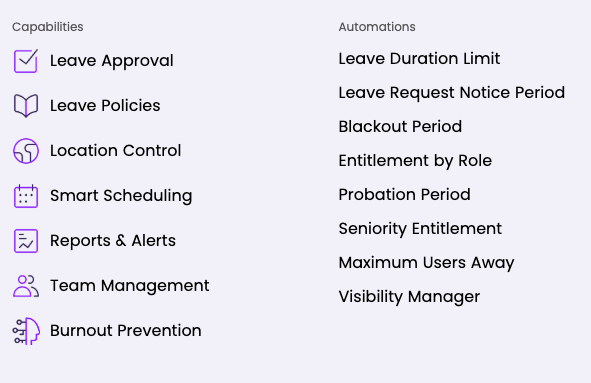
Vacation Tracker does one thing: PTO. But we do it with policy flexibility that covers every edge case you can think of. Blackout dates, probation periods, accrual caps, seniority-based entitlement, toil, multi-level approvals—we handle it all.
For companies managing team members across different countries or locations, the depth of configurability is hard to match. And because Vacation Tracker integrates natively into Microsoft Teams, Slack, or Google Workspace, checking balances or requesting leave becomes frictionless.
Setup is fast. The platform is built for self-service implementation—you can be up and running in a couple hours. Upload your users, set your company policies, and you're done.
Where Edays Excels: Sickness Management and Global Compliance
Edays customers consistently point to the platform's depth and ease of use. Their absence management scales well across countries with support for 25 different languages. Instead of making HR teams manually upload holiday schedules for each country, Edays recommends what's best for each location.
One area where Edays really stands out is sickness management. The platform tracks sickness patterns, assigns customizable sickness journeys, and calculates Bradford factor scores to help managers identify and address issues proactively. This is particularly useful for UK companies where the Bradford factor is a standard management tool.
Edays is also highly configurable without needing IT involvement. The core absence module covers leave and sickness, but you can add optional modules for core HR, time and attendance, and scheduling. You pick what you need.
Vacation Tracker's Limitations: Focused Scope
Vacation Tracker is focused on leave management. We don't cover sickness tracking, Bradford factor monitoring, or time and attendance. If you need those features, you'll need to look elsewhere or use integrations.
That said, we do have integrations with payroll systems like ADP, a Zapier integration for connecting to other tools, and an open API if you want to build custom connections.
Edays' Limitations: Pricing Transparency and Trial Access
The biggest practical barrier with Edays is that pricing isn't transparent. You can only get a demo—there's no free trial like you get with Vacation Tracker or other platforms. This makes the upfront buying process more difficult, especially if you're a team that wants to quickly evaluate a platform before committing.
The Main Comparisons: Pricing, Setup, Features, and Support
Pricing and Trials: Vacation Tracker starts at $2 per user per month and scales up to $4 per user per month for the complete plan. You can get a free trial. Edays requires a custom quote and offers a demo but no free trial.
Implementation Time: Vacation Tracker takes under a day to implement, with optional guided onboarding from our support team. Edays also offers guided onboarding, but it takes longer depending on your company's complexity.
Key Features: Vacation Tracker covers leave automation, real-time calendar syncing, customizable policies, reporting and analytics, multi-location support, and burnout prevention features so managers can track who hasn't taken vacation in a while.
Edays covers leave and absence management but extends into time and attendance, employee scheduling, and advanced reporting through their modular system.
Integrations: Vacation Tracker has native integrations with Slack, Microsoft Teams, and Google Workspace, plus payroll integration with ADP and a Zapier connection. We also have an open API.
Edays also integrates with Slack and Microsoft Teams, and they have a solid list of payroll and HR system integrations. They also have an open API.
Both platforms have apps for iOS, Android, and web.
Support and Security: Both companies offer strong support, though Edays provides a dedicated customer success manager for paying members. Both are GDPR compliant. Vacation Tracker has SOC 2 Type 2 certification, and Edays has ISO 27001 certification.
Final Verdict: Which Platform Should You Choose?
Both Vacation Tracker and Edays can handle teams coming off spreadsheets all the way up to enterprise level. The difference is in focus.
Vacation Tracker is solely focused on leave management. Edays covers leave management plus sickness tracking, time and attendance, and other HR functions.
If you're a UK company or you need more than just leave management—particularly sickness tracking and Bradford factor calculations—Edays is worth considering. But if you want something that's quick to implement, transparent with pricing, and integrates deeply into the tools you use every day, Vacation Tracker is built for that.
Good luck with your decision. If you have questions, drop them in the comments and I'll do my best to help.

Nicholas Lydon
Nick is the Content Marketing Manager at Vacation Tracker, where he turns leave management, HR headaches, and the occasional oddly specific PTO question into content people can watch. He spends most of his time creating videos, articles, campaigns, and creative experiments that make HR a little less boring.


Pricing
Starts at $2/user/month, scaling up to $4/user/month for the complete plan. Pricing is publicly available.
Requires a custom quote. No public pricing is listed; you must book a demo to get costs.
Free Trial
A free trial is available, allowing teams to evaluate the platform before committing.
No free trial is available. Edays offers a demo only.
Native Slack, Teams & Google Workspace Integration
Deep native integration with Slack, Microsoft Teams, and Google Workspace. Leave requests and balance checks happen directly inside these tools without switching platforms.
Integrates with Slack and Microsoft Teams, along with a range of payroll and HR system integrations and an open API.
Leave Policy Customization
- Supports blackout dates, probation periods, accrual caps, seniority-based entitlement, TOIL, and multi-level approvals
- Designed to handle every edge case for teams across multiple countries or locations
Highly configurable without IT involvement. Core absence module covers leave and sickness, with optional add-on modules for core HR, time and attendance, and scheduling.
Time & Attendance and Scheduling
Vacation Tracker is focused solely on leave management and does not include time and attendance or employee scheduling features.
Offers optional modules for time and attendance and employee scheduling as part of its modular HR system.
Implementation Speed
Built for self-service implementation. Teams can be fully set up in under a day—upload users, configure policies, and go. Optional guided onboarding is also available.
Guided onboarding is available, but implementation time is longer depending on company complexity and the modules selected.
Support
Live chat, email, guided onboarding, ongoing customer success management
dedicated customer success manager for paying members
Security
GDPR compliant with SOC 2 Type 2 certification.
Edays has ISO 27001 certification.