
Last updated on October 28, 2026
Your Berlin team gets 28 days of vacation. Your Austin team gets 13. On Easter Monday, London and Berlin are off while Toronto and Austin are working. On Canada Day, only Toronto is out.
None of that is a mistake. It's what happens the moment you hire in a second country. Based on what we see across 3,500+ companies using Vacation Tracker, 88% of companies with more than one location run two or more public-holiday calendars, and 63% give different allowances in different locations.
So the goal isn't to make everyone the same. It's to run one simple process on top of rules that will never match. This guide shows how, using a 120-person company with offices in Austin, Toronto, London and Berlin as the example, real numbers from our Leave Trends report (67 countries, November 2024 to September 2026) and the official law for each country.
Are there tools to handle multi-country leave policies?
Yes. Dedicated leave tools, HR-system leave modules and employer-of-record (EOR) platforms can support multi-country leave, with different responsibilities.
A dedicated tool handles requests, balances and availability. An HR-system module keeps leave alongside broader employee records. An EOR platform supports employees hired through the EOR; confirm which records your own managers still need to maintain.
Ask each provider to demonstrate:
- Separate leave policies and public-holiday calendars by location.
- Country-specific accrual and carryover settings.
- Local approvers and backup coverage.
- Approvals in Microsoft Teams or Slack.
- One calendar showing employees across countries.
Vacation Tracker supports this setup. In our data, requests approved inside Microsoft Teams or Slack had a median approval time of 32 minutes, compared with 153 minutes elsewhere.
Use our multi-location leave management tools guide to compare options against your actual policies.
How do you manage leave policies across multiple countries?
Use one global framework for requesting and approving leave, with country-specific rules for entitlements. Give each local policy a named owner and a review date.
For the 120-person company, employees in all four offices could use the same request form. Their balances, holidays and year-end treatment would follow their assigned policies.
Build a country rule sheet before configuring software:
| Rule | What to record |
|---|---|
| Annual leave | Statutory entitlement, contractual allowance, eligibility and units: hours, working days or calendar days |
| Sick leave | Separate entitlement, pay arrangements, reporting and documentation requirements |
| Parental leave | Leave categories, eligibility, pay responsibility and required notices |
| Public holidays | Country, region, observed dates and treatment of nonworking days |
| Accrual | Upfront allocation or earning schedule, with joining and leaving rules |
| Carryover | Eligible balances, caps, deadlines and exceptions |
| Notice | Booking expectations by leave type and who handles urgent absences |
| Payout | Treatment of unused leave at termination and payroll responsibility |
Keep sick and parental leave separate from vacation in your records. This lets you assign the correct rules without treating an unexpected illness like a planned summer trip.
Record who approved each policy change and when it takes effect. Otherwise, payroll and managers can end up applying different versions of the same rule.
How much leave does each country really get?
Legal minimums and recorded company allowances measure different things. Across our dataset, the median yearly allowance is 15 days, while recorded vacation taken is 11.2 days per employee per year.
Legal minimums last checked October 28, 2026.
| Country | Legal minimum (official source) | Companies give (median days) | People take (median days per year) | Book ahead (median days) |
|---|---|---|---|---|
| US | No paid-vacation requirement under the federal FLSA; certain federal contracts have separate requirements | 13.1 | 8.8 | 14 |
| Canada | Federally regulated employees: 2 weeks after 1 year, rising with service; provincial and territorial rules differ | 15 | 10 | 18 |
| UK | 5.6 weeks for almost all workers; bank holidays can count toward this | 25 | 12.4 | 22 |
| Germany | 24 working days on a six-day week, equivalent to 20 on a five-day week | 28 | 13.5 | 14 |
| Spain | 30 calendar days, under Workers' Statute Article 38 | 23 | 13.9 | 16 |
| Netherlands | Four times weekly working hours, equivalent to 20 days on a five-day schedule | 25 | 15.3 | 16 |
| India | Varies by state and applicable employment law; see the Delhi Shops and Establishments rules for one jurisdiction | 15 | 11.6 | 7 |
| Australia | 4 weeks under the National Employment Standards for non-casual employees; eligible shiftworkers receive more | 20 | 9.2 | 11 |
The company figures describe recorded allowances and usage, not national legal compliance. Allowance means the main policy's yearly quota; days taken means recorded vacation over the last 12 months.
Spain's calendar-day minimum cannot be compared directly with a working-day allowance. UK bank holidays may be included in statutory entitlement but handled separately in a company's calendar.
Toronto also needs a provincial check: Ontario's minimum is two weeks for employees with less than five years of employment and three weeks with five or more, subject to coverage and exemptions.
For every other country, see annual leave around the world.
Same days for everyone, or local rules?
Both approaches can work; 63% of multi-location companies in our data vary allowances by location. Choose between local allowances and a global floor before negotiating individual exceptions.
Under a local model, Berlin and Austin can have different allowances based on their respective requirements and employment markets. Explain the basis to employees rather than leaving managers to defend the difference individually.
A global floor gives everyone a baseline, with higher local entitlements preserved. We'd recommend this approach when the company can afford the additional time off and wants a clearer starting point for new-country hires.
If you set a global floor, don't let it cut a higher local allowance. A 20-day floor shouldn't quietly take Berlin from 28 days down to 20.
How do you handle public holidays across countries?
Maintain a holiday calendar for each country, then separate locations where regional holidays differ. Our data shows a median gap of eight public holidays between two locations, compared with two between US locations.
For Austin, Toronto, London and Berlin, record the relevant region as well as the country. Add company-wide closure days to every affected calendar. Review observed dates before opening next year's booking window.
Check regional calendars during setup, including German states, Spanish regions and Canadian provinces. Confirm which dates apply to your employees before importing a national list.
If you want to narrow differences in total days off, consider floating days. Decide whether those days are extra vacation or a separate allowance, who qualifies, and how employees request them.
Our holiday tracker software guide covers tools for keeping those calendars together.
Remote and EOR employees: whose rules apply?
Start with where the employee habitually works, not just where headquarters sits. For EU employment contracts, Rome I Article 8 uses habitual work location as a central rule, with exceptions; a chosen law cannot remove applicable mandatory protections.
For a Berlin employee reporting to Austin, don't assign the Austin policy simply because their manager works there. Record the work country, region and employing entity during onboarding.
An EOR is the legal employer, but your managers still need to know when that employee is unavailable. Agree who confirms entitlement, records requests and communicates changes to payroll. Reconcile the EOR's records with your team calendar.
Require an HR review before employees move countries. A permanent move and a temporary trip need separate assessments. Track contractor availability separately, and review classification rather than assuming an employee PTO policy settles their status.
Sidenote: This is operational guidance, not legal advice. Check local law and counsel before adopting a policy or changing an employee's work country; our leave-law guides provide a starting point.
Leave years, carryover and payout when someone leaves
Record the leave year, accrual schedule and exit treatment separately for each location. A shared calendar does not require identical balance-reset dates.
Choose calendar-year, fiscal-year or employment-anniversary settings to match each approved policy. Then distinguish a lump-sum allocation from accrual: the former grants an allowance upfront; the latter earns it over time.
Use the PTO accrual calculator to check your arithmetic before configuring balances. Test a midyear joiner and a departing employee, not just someone employed for the entire year.
Avoid one blanket "use it or lose it" rule. Germany's Federal Leave Act, Section 7 addresses calendar-year use, limited carryover and compensation when employment ends. The Federal Labour Court also explains why employer notice obligations and illness affect expiry. Setting a software deadline does not settle those questions.
US rules also need state-level treatment. For Austin, the Texas Workforce Commission says accrued-leave payout under the Texas Payday Law depends on a written policy or agreement promising it. In the UK, employers must pay for untaken statutory holiday when employment ends.
Before closing an employee's record, reconcile entitlement earned, leave taken and any protected carryover with payroll. Our PTO rollover guide explains the policy settings to document.
How do you manage PTO for a team across multiple time zones?
Give each team an approver with overlapping working hours and a backup, then check coverage across locations before approving vacation. Requests approved inside Microsoft Teams or Slack had a median turnaround of 32 minutes, versus 153 minutes elsewhere.
For the example company, London's requests should not depend on the Austin manager opening their inbox. Assign decision authority, specify when the backup takes over, and make the shared calendar part of the approval check.
Set notice expectations by location and leave type. Median booking lead time is 22 days in the UK and seven in India. Build an urgent-absence route rather than applying vacation booking rules to every leave type.
Check coverage by function as well as office. If Berlin and Toronto share support duties, reviewing their calendars separately can hide a gap. Set a maximum planned absence level per team and name the person covering each essential responsibility.
Plan peak weeks early. Christmas week accounts for 6.5% of all vacation days in the dataset; Australia's week 52 accounts for 14.5% of its vacation days. If the company later adds an Australian team, don't assume its December availability will match Austin's.
How to track global employee leave in one system
Vacation Tracker lets teams request, approve and track PTO through Microsoft Teams, Slack or Google Workspace, with location-specific policies and a shared calendar. Here is how you would track PTO for this team in Vacation Tracker.
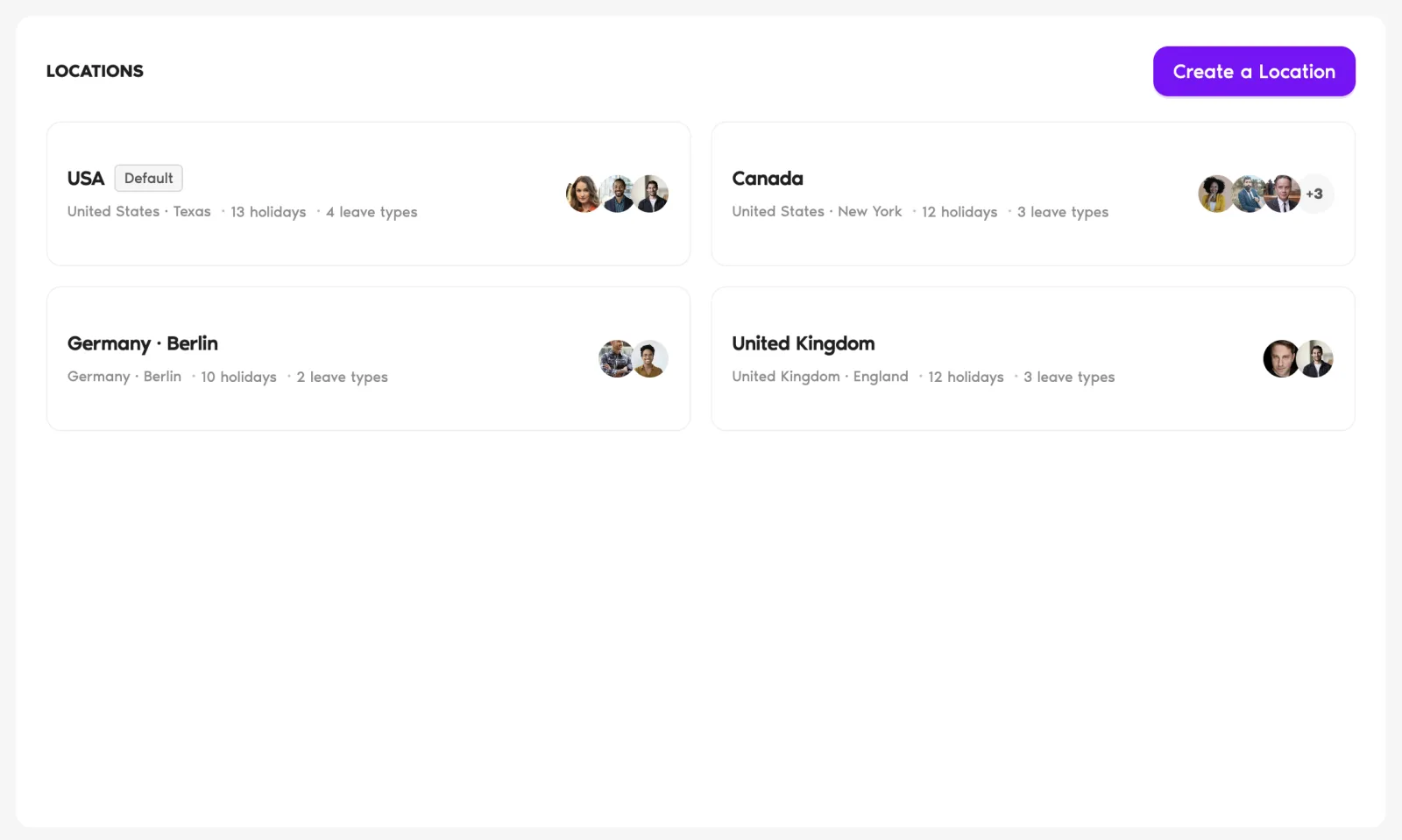
1. Create a location for each country
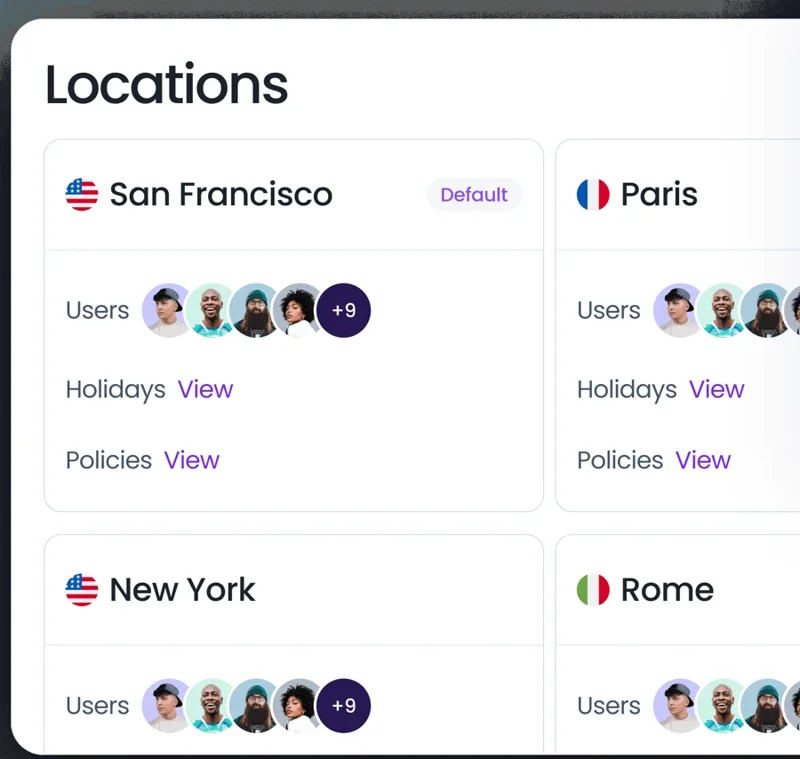
Set up Austin, Toronto, London and Berlin with the correct country, region, time zone and workweek. Split locations further when employees need different holiday calendars or policies.
2. Import public holidays for each location
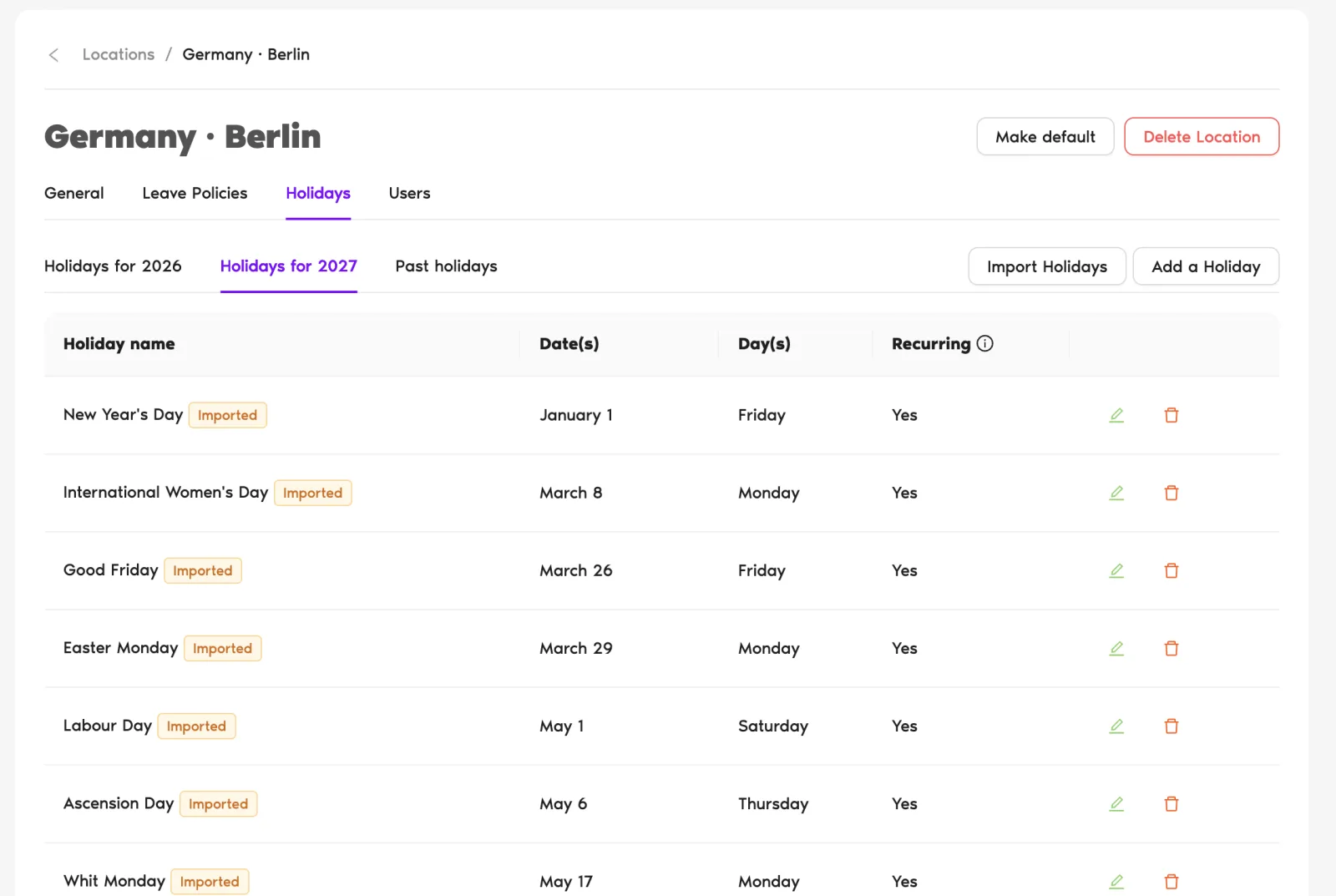
Import a country's public holidays for each location and select the relevant region. Importing holidays into Vacation Tracker is easy. Simply select your country or region through Import Holidays in Locations, and the holidays will be imported automatically. Review the list, then add company-wide closure days to each affected location's calendar.
3. Set leave policies by location
Create the leave types you need, then configure each location's allowance, approval requirements and carryover. Vacation Tracker lets you customize quotas, accruals, and other leave settings for each location and leave type. Use Complete's accrual settings where the policy earns leave over time. Check opening balances before employees start booking.
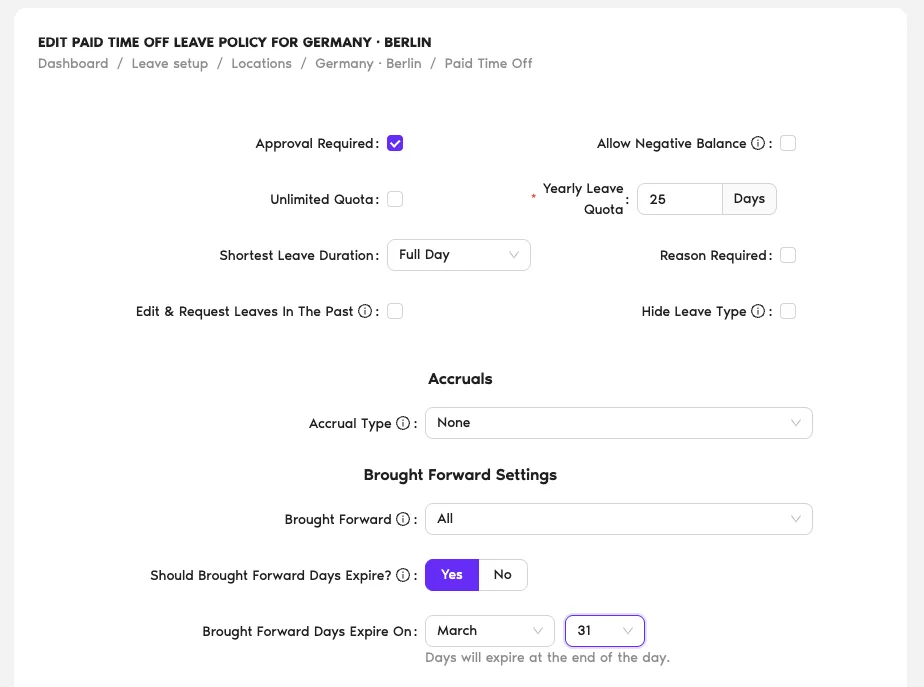
4. Assign location admins and approvers
Location admins manage settings for their locations, while approvers handle leave requests for their assigned departments. You can assign both roles to the same person or keep them separate, and set up substitute approvers to handle requests when someone is away.
5. Share the calendar and daily availability
Open the Wallchart to see the whole company on one timeline. Every approved leave, every public holiday and every office appears side by side. Filter by location to check Berlin before you approve a request in London. Filter by department to check that your support team is covered across all four offices.
Then set up daily and weekly summaries of who's out. Pick the channel, the time and the locations or departments each summary covers. Teams on Microsoft Teams or Slack get them in a channel. Google Workspace and email teams get them in their inbox. Approved leave also syncs to Google Calendar or Outlook, so everyone sees absences in the calendar they already use.
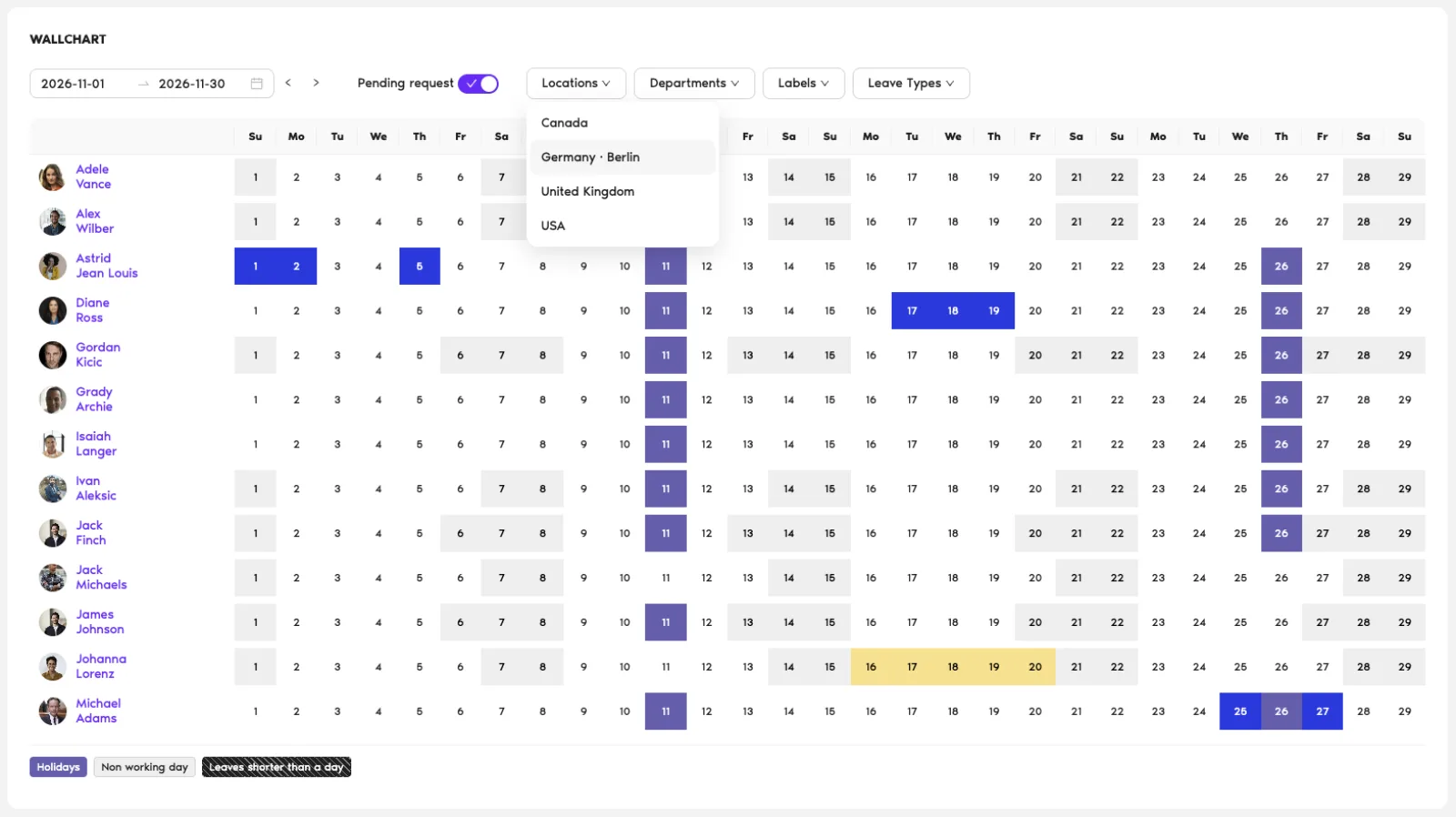
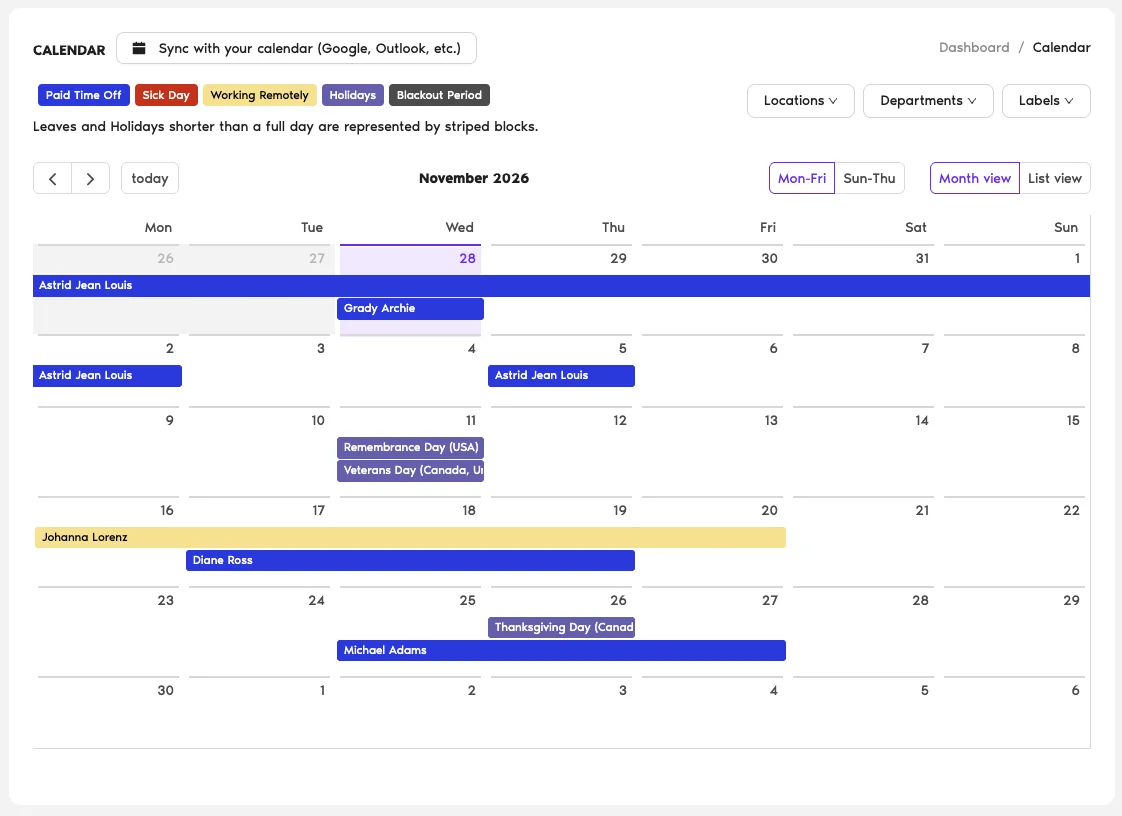
That's the whole setup: one location per country, its own holidays and policies, and one calendar that shows everyone. Your team in Berlin, London, Toronto and Austin requests leave the same way, and every request follows the right local rules automatically. For a step-by-step walkthrough, see our full multi-location setup guide.
Manage leave across all your locations
Leave policies and public holidays for every office, state or country, in Microsoft Teams, Slack or Google Workspace.
Sources
The operational benchmarks come from Vacation Tracker's Leave Trends report, which is based on anonymized leave data. Country minimums were checked against these official sources on October 28, 2026:
- US: Department of Labor, vacation leave.
- Canada: Federal annual vacations; Ontario vacation standards.
- UK: Holiday entitlement.
- Germany: Federal Leave Act, Section 3.
- Spain: Workers' Statute, Article 38.
- Netherlands: Dutch government business portal, holiday entitlement.
- India: Delhi Labour Department, Shops and Establishments inspectorate.
- Australia: Fair Work Ombudsman, annual leave.

Lav Crnobrnja

The COO and co-founder of Vacation Tracker. He loves sharing his knowledge and passion for startups, business, and AI. When he’s not working, he can often be found experimenting with AI agents and exploring what the latest technology can do.