
Last updated on May 15, 2026
UK Employees Are Leaving Vacation Days Unused and Burning Out Because of It
New workplace data from the UK paints a pretty concerning picture. Millions of employees likely aren't taking the time off they've earned, and burnout could be getting worse because of it.
Check it out with this video here:
The Numbers Are Worse Than You Think
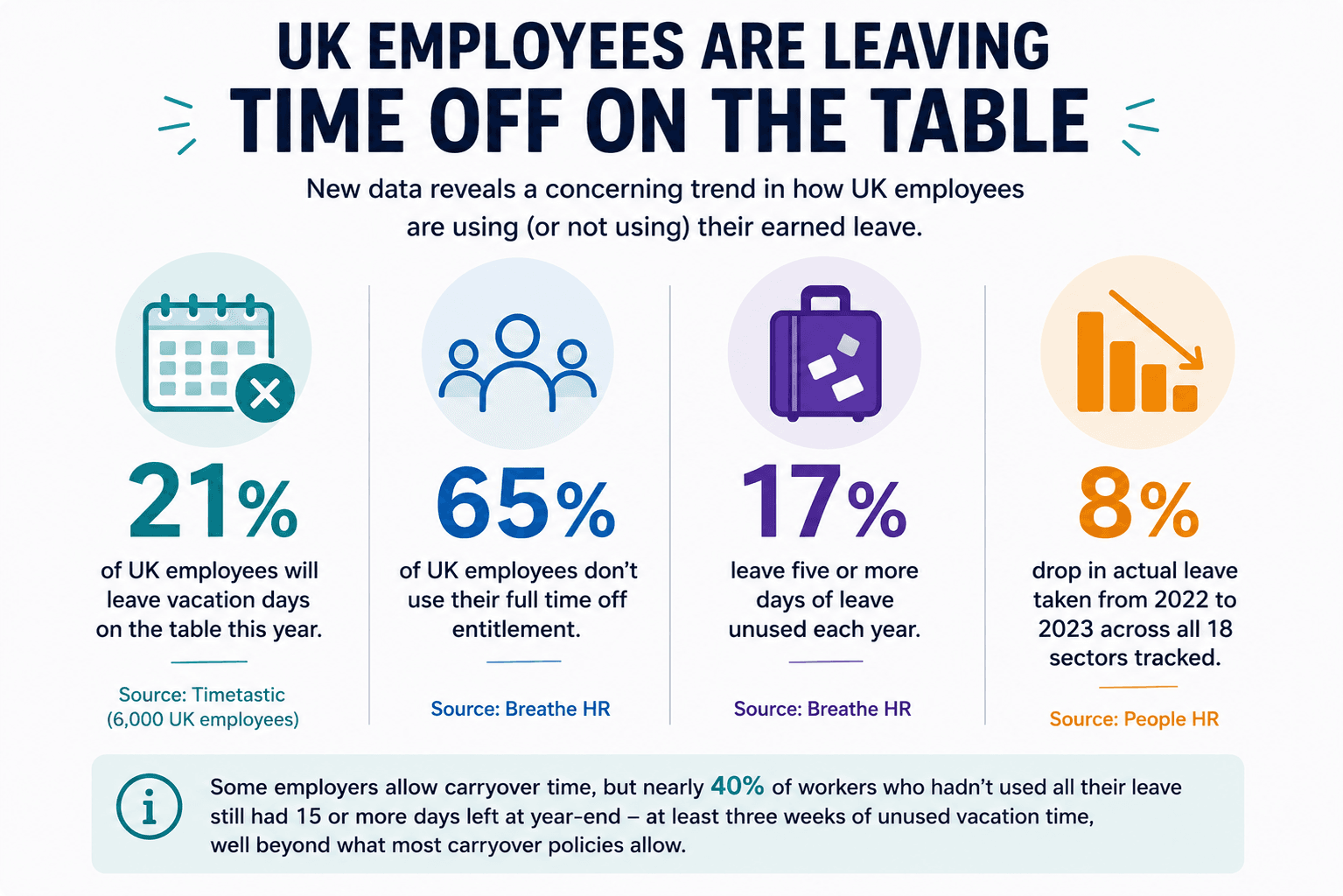
Timetastic just surveyed 6,000 UK employees and found that nearly 21% will leave vacation days on the table this year. But that might be an understatement.
A separate survey by Breathe HR found that 65% of UK employees don't use their full time off, with 17% leaving five or more days at the end of each year. And People HR found that actual leave taken fell 8% from 2022 to 2023 across all 18 sectors they track.
Some employers allow carryover time, so not all unused days are necessarily wasted. But here's where it gets strange: of workers who hadn't used all their leave yet, nearly 40% still had 15 or more days left at the end of the year. That's at least three weeks of unused vacation time, well beyond what most carryover policies allow.
People Know Time Off Helps, But They Still Don't Take It
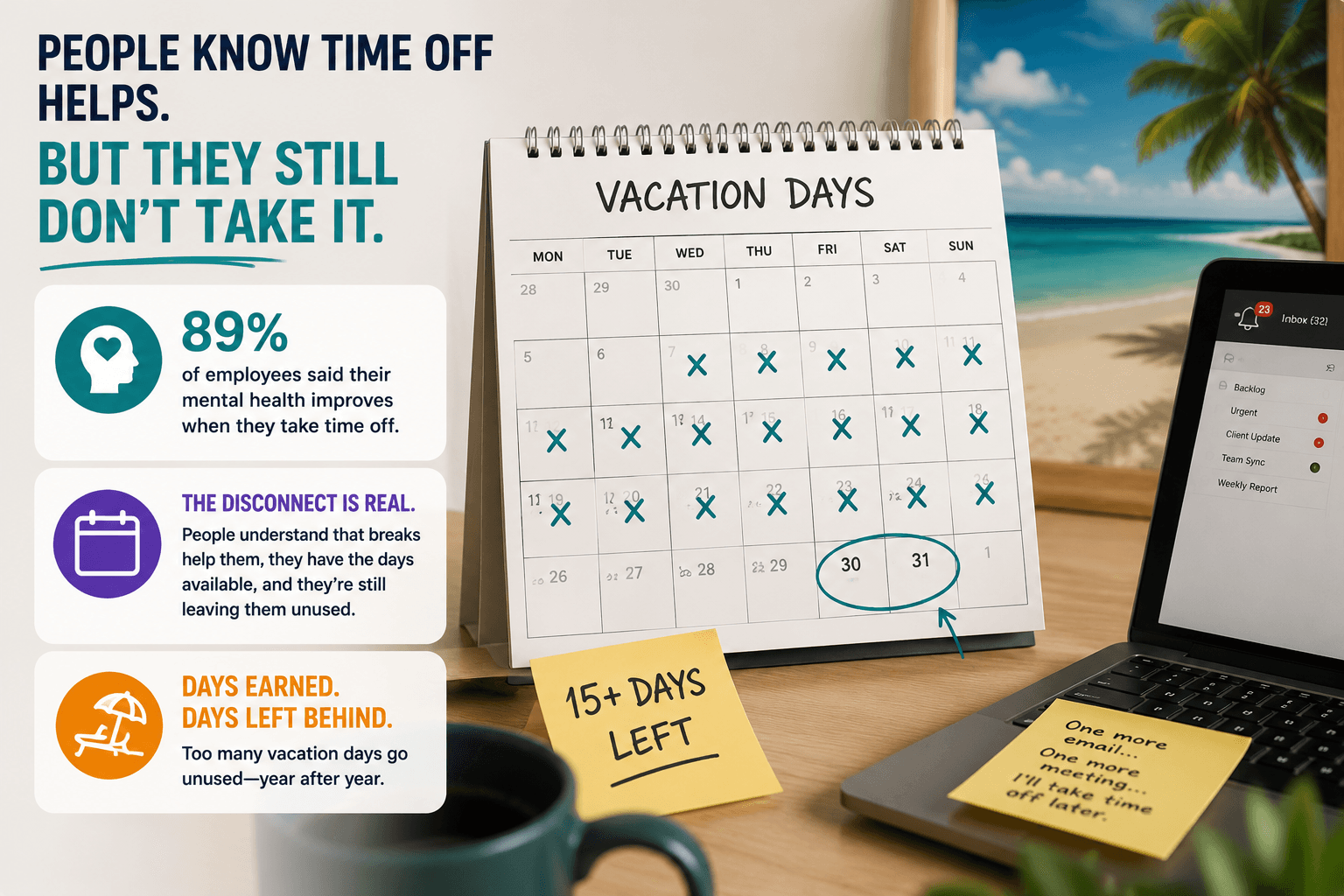
Here's what makes this genuinely weird: 89% of respondents said their mental health improves when they take time off. They're not skeptical about the value of vacation. They're just not doing it.
The disconnect is real. People understand that breaks help them, they have the days available, and they're still leaving them unused.
Young Workers Actually Use Their Vacation Days
I assumed younger people would take less time off because they're trying to prove themselves and build their careers. Turns out I was completely wrong.
The 18-24 age group had the highest uptake of time off. 82% of that age range said they used all their vacation days. So the "always on" mentality isn't coming from the youngest workers.
Middle Managers Are Getting Squeezed the Hardest
Only 1% of senior-level managers said they felt pressure not to take time off. But 26% of general managers and supervisors in the middle layers felt they couldn't take any time off.
This is the group responsible for day-to-day operations while still being accountable to people above them. They're trying to keep everything under control, and it makes them feel trapped. This is what leads directly to burnout.
The Burnout Connection Is Clear
Timetastic asked everyone in their survey how long they'd gone without taking a break. The results:
- 39% had gone 2-3 months
- 29% had gone 4-5 months
- Nearly 25% had gone 6 months or more
And everybody in that last group reported stress at work had increased during that time.
This isn't just one survey either. Mental Health UK's burnout report found that 9 in 10 adults experienced high or extreme levels of pressure in the last year. One in five people had to take time off due to stress-related mental health issues.
The burnout problem is real, and it's not just about personal well-being. It's a structural economic problem too.
How We're Trying to Fix Part of This Problem
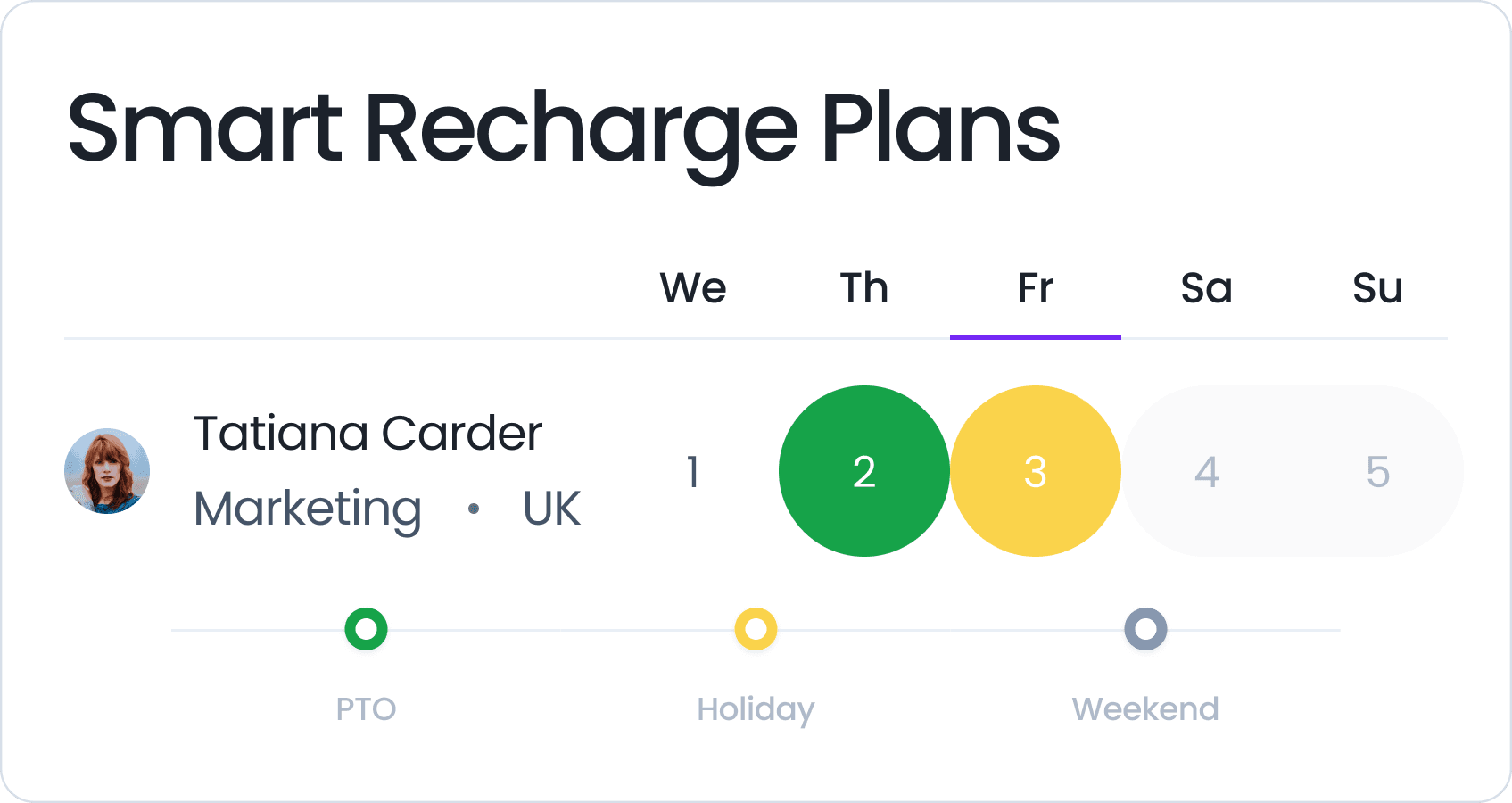
At Vacation Tracker, we've been working on tools to address this. We're a PTO and leave tracking platform that integrates into the places you already work (Slack, Teams, etc.).
But the burnout issue has been apparent for a while, so we built a feature called Recharge. It suggests time off based on how long you've gone without taking a break, while taking your team's vacation plan into account. This way you're never short-handed, and you can take time off without feeling guilty about it.
For managers, this means you can see who hasn't taken time off in forever and have a conversation about it before it becomes a problem.
Try Vacation Tracker here if you want to give it a shot.
The Practical Fixes Are Unglamorous But They Work
Beyond software tools, the interventions that actually help are pretty straightforward:
- Plan ahead so there are no last-minute scrambles
- Be explicit that non-essential work can wait until someone returns from vacation
- Have top-level managers model healthy time-off behavior to lower-level employees
That last one truly makes a difference in company culture. When senior leaders visibly take time off and disconnect, it gives everyone else permission to do the same.
This Is About More Than Just Taking Days Off
The data points to Britain having a serious leave problem. But it's not about taking days for the sake of taking days. It's about what those days mean for work environments.
When nearly a quarter of the workforce goes 6 months or more without any break, and all of them report higher stress levels, it impacts the work environment and individual employees. The "always on" culture isn't sustainable, and the numbers support it.
Take your vacation days. Your mental health (and your team) will thank you for it.
Reources:
[^1]: Breathe HR, August 2024 — survey of 1,000 UK employees. Reported by HR Magazine. [^2]: Access PeopleHR Annual Leave Report, 2024. Reported by Personnel Today.
[^3]: Mental Health UK, Burnout Report 2026. Published March 2026.
[^4]: MHFA England, Key Workplace Mental Health Statistics, 2024.
[^5]: Resource Guru, State of (Over)working 2025 — survey of 2,000 UK desk workers.
Core data throughout from: Timetastic, 2026 Annual Leave Report — survey of 6,000 UK respondents.

Nicholas Lydon
Nick is the Content Marketing Manager at Vacation Tracker, where he turns leave management, HR headaches, and the occasional oddly specific PTO question into content people can watch. He spends most of his time creating videos, articles, campaigns, and creative experiments that make HR a little less boring.